

Remembering Our Selves
The Neuroscience of Memory in "Still Alice"

“Even then, more than a year earlier, there were neurons in her head, not far from her ears, that were being strangled to death, too quietly for her to hear them.”
—Lisa Genova, “Still Alice”
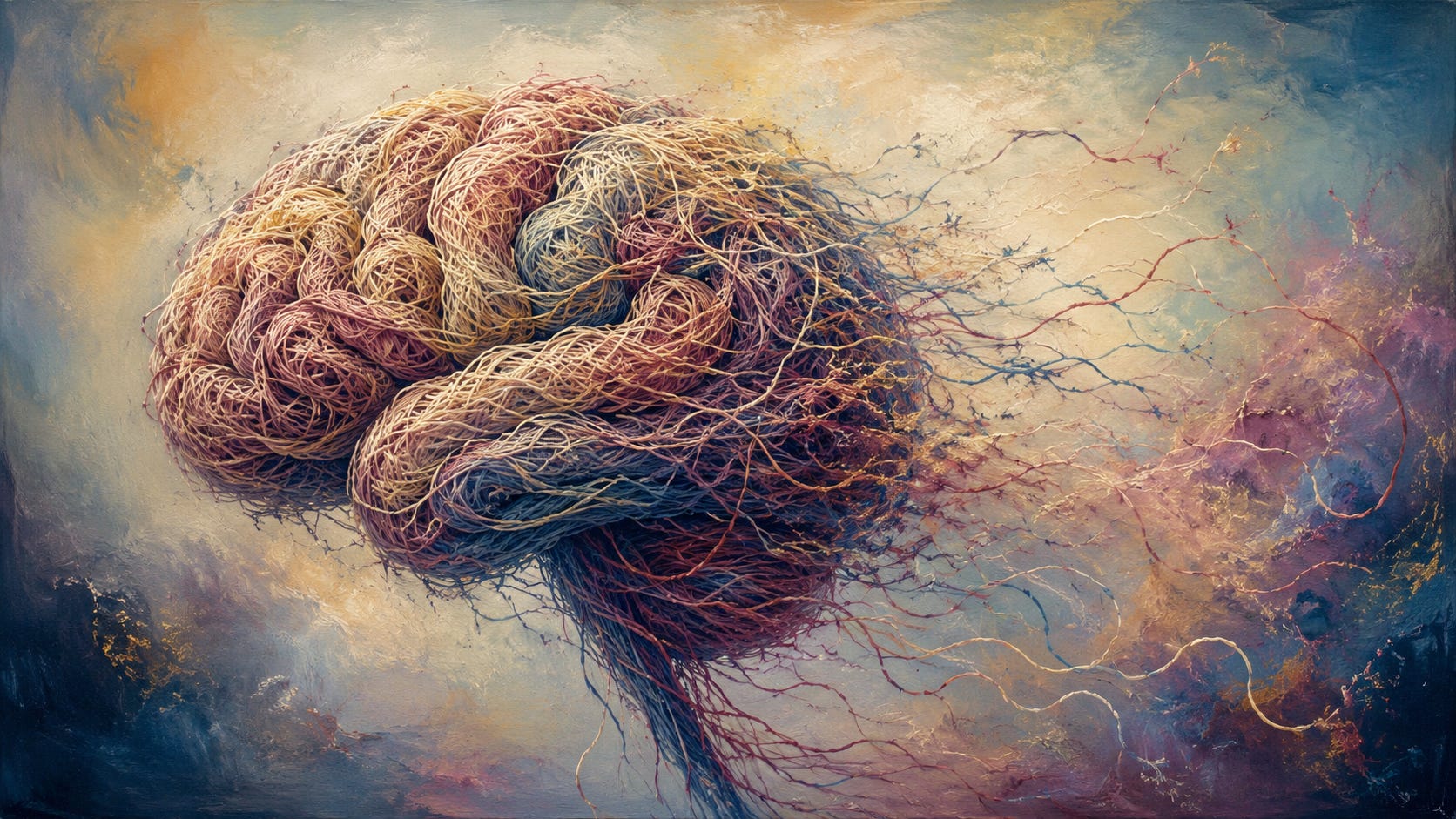
We think of ourselves as a continuous thread. I am the same person who once learned to ride a bike, who fell in love with my husband, who is reading this sentence now. Memory is what binds the thread together.
Remembering begins with attention. The brain cannot retain everything, so it chooses what’s important. What it chooses is shaped by who we are. The mother registers the catch in her child’s voice before the words. The architect sees the line of a roof against the sky. We attend to what matters to us, and what we attend to becomes what we keep.
Author Lisa Genova is uniquely qualified to write about memory.1 A Harvard-trained neuroscientist, she left the lab to write novels about the diseases she had studied. Still Alice, her first, is essentially a scientific paper written as a human life. Its protagonist, Dr. Alice Howland, is a Harvard professor at the height of her career in linguistics, the author of more than a hundred academic papers, a scholar who can summon her sources at will. “Alice frequently awed her students and post docs by offhandedly rattling off the seven studies relevant to a certain phenomenon, along with their respective authors and years of publication.”
The hippocampus is the brain’s weaver of memory. It registers what is salient and knits the threads of an event into a single pattern the brain can later recall. What gets stored is not just the information, but everything around it—the smell of the room, the slant of the light, the emotion of the moment. Each thread is held in the part of the brain that first received it, and any one of them can summon the whole.2 The olfactory bulb keeps the smell. The visual cortex keeps the light. The amygdala keeps the feeling. The hippocampus binds them together.
When researchers slide subjects into an MRI and ask them to recall a memory, the brain lights up all over, searching for a cue. Once it finds one, the regions that lived the moment fire again in the same pattern.3 We do not pull memories from a drawer. We relive them and, in the process, reconstruct an echo of the self that first experienced them.
Alice is an accomplished speaker who enjoys “all the concatenated moments of presenting in front of a listening audience—the teaching, performing, telling a story, teeing up a heated debate.” One day she is at a conference at Stanford, forty minutes into a fifty-minute talk on the main tenets of linguistics. She has given the talk many times. Many of the discoveries in it are from her own lab. She is speaking without notes, relaxed and animated.
Mid-sentence, she stops. The word she needs is a word she has used a thousand times, in this exact talk, on this exact slide. “She simply couldn’t find the word. She had a loose sense for what she wanted to say, but the word itself eluded her. Gone.”
Hours later, descending into LAX, it returns to her.
Lexicon.
A few similar moments accumulate, and Alice goes to her doctor seeking answers. After a series of tests, the diagnosis comes back—early-onset Alzheimer’s.
She is only fifty years old.
Scientists now believe that Alzheimer’s disease is driven by two slow assaults. Beta-amyloid plaques gather between neurons, and tau protein tangles grow within them.4 The plaques come first, disrupting the neural connections along which information travels. The damage begins in the hippocampus. Recent memories are the first to dissolve, and new ones become difficult to form.
Some brains are slower to surrender. A lifetime of consistent learning builds redundancy into the brain, allowing the same piece of information to be reached by many different pathways. When one route is blocked by plaques, other options remain open.5
Alice has spent her career building exactly this kind of density. She has a plethora of knowledge, memory tricks, cognitive reasoning strategies. These strategies become tethers holding her self in place a little longer.
But even the most synaptically dense brain runs out of defenses. The disease spreads beyond the hippocampus into the parietal lobe, where we store spatial and navigational information. We begin to get lost in familiar places.
Alice is on a run one afternoon, on a route she takes almost daily. She looks up at an intersection and freezes. “She didn’t know where she was…She knew she was in Harvard Square, but she didn’t know which way was home…this square had been her stomping ground for over twenty-five years but…somehow didn’t fit into a mental map that told her where she lived…It all lacked a context.”
Then on Christmas Eve, Alice stands at the counter with ingredients for her mother’s recipe for white chocolate bread pudding. It’s a recipe she has made every year since she was a girl. She hasn’t looked at the paper in decades. But this year, it all looks foreign. “How many eggs?...Was she supposed to use all of the cream, or measure out only some of it?...Was she supposed to combine everything all at once, or in a particular sequence?...At what temperature did she bake it and for how long? No possibility rang true. The information simply wasn’t there.”
The disease has reached the basal ganglia, where muscle memory lives, the deep procedural knowledge of how our bodies move through the world. We forget how to do the things that once came without thinking—cooking, driving, eventually even eating. Her mother’s recipe, kept all these years inside her, is gone.
Eventually, Alzheimer’s reaches the prefrontal cortex, the region that governs critical thinking, problem-solving, and the knowledge of who we are in a room.
One day, Alice arrives at the classroom where she has lectured for years. She worries she is late, but nothing has started. She takes an aisle seat, four rows back. She waits for class to begin, wondering where the professor is. She does not know she is waiting for herself.
In the disease’s later stages, the tau tangles that have been gathering inside the neurons begin to strangle them. Cells die. The damage spreads deeper into the hippocampus, and even the oldest threads of memory come loose.
Within a few short years, Alice can no longer teach. She can no longer run. She can no longer be left alone. She can no longer recognize her own children. Eventually, even her husband of more than twenty-five years, becomes a “kind stranger.”
So many of the threads that once defined Alice have come loose. Her sense of herself is “like a soap bubble, ever higher in the sky and more difficult to identify, with nothing but the thinnest lipid membrane protecting it from popping into thinner air.”
And yet, something remains.
At the end of the novel, Alice sits in a living room with her family. One of her daughters reads a scene for an upcoming play aloud. Her other daughter sits nearby, with her infant son in her arms. To Alice, they are just a beautiful actress, a gentle mother, and an adorable baby. She doesn’t know their names, or even her own. But as the actress reads, as the baby coos, Alice is still Alice. She still feels the shape of what is being given to her:
“I feel love. It’s about love.”
I owe thanks to Brigitte Kratz for her keen editing eye on this one!
The neuroscience throughout this essay draws on another book of Lisa Genova’s—Remember: The Science of Memory and the Art of Forgetting (Harmony, 2021), an instant New York Times bestseller and her first work of nonfiction. Genova holds a Ph.D. in neuroscience from Harvard University and has been called the Oliver Sacks of fiction and the Michael Crichton of brain science. Her TED talks on memory and Alzheimer’s have been viewed over 11 million times.
This is why a smell can surprise us by triggering an old memory ◡̈
M.E. Wheeler, S.E. Petersen, and R.L. Buckner, “Memory’s Echo: Vivid Remembering Reactivates Sensory-Specific Cortex,” Proceedings of the National Academy of Sciences 97, no. 20 (2000): 11125–11129. Subjects learned a set of picture and sound items and were then given a recall test during which they vividly remembered the items while being imaged with event-related fMRI. Regions of visual and auditory cortex were activated differentially during retrieval of pictures and sounds, respectively, and the regions activated during recall comprised a subset of those activated during a separate perception task in which subjects actually viewed and heard the items. Buckner described the finding as “memory’s echo in the brain—activity associated with the stored memory that momentarily bounces back to our awareness when we attempt to remember.”
Two-thirds of all persons with late-onset Alzheimer’s disease are women. The reasons are not yet fully understood, and the question is only now beginning to receive sustained research attention. Female longevity alone does not appear to explain the disparity. Neuroscientist Lisa Mosconi, director of the Women’s Brain Initiative at Weill Cornell Medicine, has been a leading researcher in this area; as she has put it, “our brains age differently, and menopause plays a key role here for women.” In a 3-year longitudinal brain-imaging study of 59 cognitively normal adults ages 40–60, Mosconi and colleagues found that peri- and postmenopausal women showed Alzheimer’s-related biomarker changes, including declines in cerebral glucose metabolism, hippocampal volume loss, and, in postmenopausal women, higher rates of beta-amyloid deposition compared with men. See Mosconi et al., “Increased Alzheimer’s risk during the menopause transition: A 3-year longitudinal brain imaging study,” PLoS ONE (2018), and Mosconi’s books The XX Brain (2020) and The Menopause Brain (2024).
The concept of cognitive reserve was pioneered by neuropsychologist Yaakov Stern of Columbia University. In a landmark 1992 study, Stern and colleagues found that among Alzheimer’s patients matched for clinical severity, those with higher levels of education exhibited significantly greater underlying brain pathology, indicating that education or its correlates “may provide a reserve that compensates for the neuropathological changes of AD and delays the onset of clinical manifestations.” See Y. Stern, G.E. Alexander, I. Prohovnik, and R. Mayeux, “Inverse relationship between education and parietotemporal perfusion deficit in Alzheimer’s disease,” Annals of Neurology 32, no. 3 (1992): 371–375.
Stern later elaborated the broader theoretical framework in “What is cognitive reserve? Theory and research application of the reserve concept,” Journal of the International Neuropsychological Society 8, no. 3 (2002): 448–460. There, he distinguishes between passive “brain reserve” or threshold models and more active models of cognitive reserve, in which the brain may preserve performance through more efficient use of existing networks or greater flexibility in recruiting alternate networks. He also distinguishes reserve from compensation. Reserve helps optimize or maintain normal performance, while compensation refers to the recruitment of brain structures or networks not ordinarily used when the brain is undamaged, in an effort to sustain performance in the face of pathology.
Ugh, this is so heart-wrenching and scary.
When I was pregnant with my son, I sat in my bed one evening reading a book. I was more than halfway through. I knew all the characters and the story and the plot. But I started the chapter and didn't recognize any of the names. I was so confused, I must have skipped ahead. So I went back to the previous chapter, then the next, then the next. I went all the way back to the beginning of the book, and that's when I really got scared, because all of it was foreign. I didn't recognize any of the characters' names. I shut the book and waited for my husband to get home from his walk. He came up to me beside the bed and told me he ran into our neighbor, the one with the friendly dog we liked. He said their names—Theresa and Sunshine. I stared at him, knowing I should know who he was talking about by the look on his face, but having absolutely no idea who Theresa and Sunshine were. We both got scared and went to the Emergency Room. By the time I arrived my memory was back. I remembered our neighbors' names, and the next day, I went back to where I was in my book. The amnesia was brief, maybe thirty minutes, but reading this post brought me back to it. Such a scary disease.
Thank you Rachel for writing this. So sorry to hear Alzheimer’s has been a part of life your family has had to navigate. This was a wonderful post. Really enjoyed the balance of story and science in this one. The title is perfect.
One of the hardest things I’ve seen through two parents (MIL with Alzheimer’s, she lived with us for ~6 months before agreeing to go to a memory care facility, and my own mother with LB dementia) is how unforgiving it is on family members. As the patients lose themselves, often times loved ones lose their own sense of self, portions of it at least, trying to care for them. It is the ultimate test of saving someone who’s drowning, which, in the water, sometimes also results in the rescuer drowning. My only advice for people is to try and make yourself as healthy as you can before the storm, physically, mentally, in your relationships, in your faith, if that’s a part of your life. That part of your essay genuinely made me smile, about the connections we make in our brains, and less scientifically, in our hearts, to help stave off or slow the effects. I saw Still Alice before my MIL and mother were diagnosed. I should read the book at some point but my memories of the film, significant sadness at the time, now seem quaint as I look back on it. Reading about the end of the book here in this post helped provide some hope at a point where I don’t feel or find much in that disease. Appreciate what you bring to your writing on here. 🙏