

Sit here.

When my dad entered hospice last fall, I realized how little I knew about dying. I wrote this for anyone who has walked through a similar loss, and for anyone who hasn’t yet.
One note before you read: the essay describes the physical process of dying in close detail, including my father’s final hours. If your grief is fresh, those passages may be hard.
I knew, of course, that my dad would die one day.
But I knew it the way I knew the sea was rising, or that the sun would one day swell to consume the earth. A distant fact, too large and blurry to hold, easily pushed behind laundry and email.
So many of the things we know, we know only like this, until we sit down beside them.
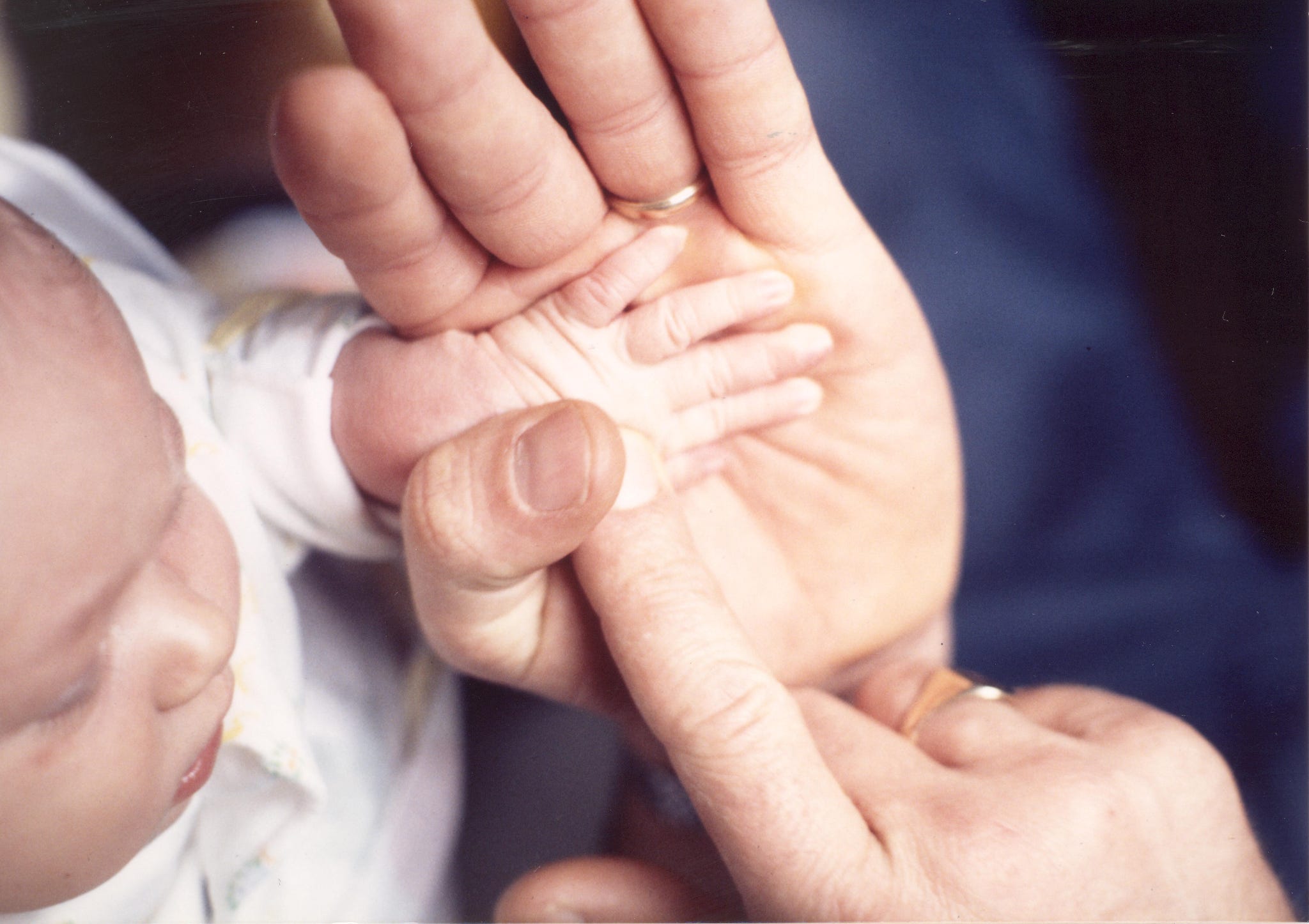
The day I was born, my dad took a photo of my newborn hand in his. He couldn’t get over how small my fingers were, the tiny crescents of my nails. As I grew, it was the size of his hands I noticed—the sturdiness of them, how much they could hold.
When I was a toddler, I would sit on our front stoop and pat the spot beside me. “Sit here,” I’d tell Dad.
He always did.
On October 10th of last year, afternoon sun slanted through the perfectly square window of a perfectly square room at Johns Hopkins. I fixed my eyes on a small water stain behind the doctor’s shoulder as he said the words: stage four pancreatic cancer. It had spread to Dad’s liver, his lungs.
Just a week earlier, we’d taken a three-mile hike for my mom’s birthday. Dad had pointed out wildflowers and other plants to my kids and talked to me about the mycelial network. He walked beside us in his beloved Merrell hiking boots, his right foot turning outward the way it always did, none of us knowing what was growing inside him.
The weeks that followed were a frenzy of tests and phone calls, attempts to find a clinical trial or begin chemotherapy. We were frantic for the next doctor, the next experimental treatment, the next thing that might put more distance between Dad and death. He was in and out of the hospital with blood infections and procedures. After his second hospital stay, he told us he was done. He just wanted to go home.
When we called hospice, they handed us a folder crowded with prescriptions, phone numbers, forms to sign. Tucked inside was a little blue booklet. On its cover, a clip-art ship sailed toward a pencil-drawn horizon. The title, in plain type, read Gone From My Sight: The Dying Experience.
Its author, Barbara Karnes, spent decades as a hospice nurse sitting beside the dying. What often frightened families most, she learned, was the not knowing. They had seen dying only in movies, where it came as a final profound sentence, a closing of the eyes, a quiet slipping away. Real dying was slower and stranger, and they often mistook it for suffering.
So Karnes compressed what she knew into fourteen pages written plainly enough for a child and, even in those frenzied weeks, plainly enough for me. She explained that we labor our way into this world through a body, and we labor our way out of it through one, like a chick wriggling free of its shell. Then, stage by stage, she described how the body begins to let us go.
When he got back home, Dad spent hours each day lying alone upstairs in his bedroom, wearing a sleep mask and noise-canceling headphones. In his palm, he held a stone he’d found on a walk earlier that year.
His sudden isolation terrified us. We thought he was depressed. We talked about SSRIs and whispered to one another that he was giving up too soon. We begged him to get out of bed, to exercise. He tried, taking painfully slow walks up and down the stairs.
The blue booklet’s first heading, written in all caps, was WITHDRAWAL. As dying becomes real, Karnes wrote, a person begins to retreat from the world around them. Attention turns inward, toward the quiet work of taking stock of a life.
As I read, I saw my father lying beneath his sleep mask, the stone moving slowly between his fingers. I could hear him, ever the scientist, explaining to all of us—even the hospice nurses—that the stone came from the Quaternary period and had sheared away from a rock face 2.6 million years ago. Water and time had worn it smooth and symmetrical, he told us, the same way life had shaped him. The way it shapes all of us. He called it his soul stone.
I thought, too, of the labored walks he had taken because we asked him to. What we had called giving up took on a new, humbling shape. Even as his body was beginning to shut down, as his soul was reckoning with eternity, he was still trying to take care of us.
The next section of the booklet was titled simply FOOD. “When a body is preparing to die,” Karnes wrote, “it is perfectly natural that eating should stop.” Hunger exists to sustain a body still reaching toward life. On the page, it made sense. Then I watched my mom keep cooking.
She carried plates upstairs on the same acrylic tray she had used to bring me chicken noodle soup when I was sick as a little girl. “One more bite,” she’d urge, as though each one might keep him here a little longer. I would stand in the doorway, knowing his body was done with food and also knowing why she could not stop trying.
Near the end, Dad wanted only fruit popsicles—raspberry, mango, peach. My youngest brother would wrap the wooden handles in paper towels before carrying them upstairs, one of the final gifts we had left to give. Later, I would find their remnants tucked into sandwich bags in the freezer, each one a bit larger than the last. Little jeweled mile markers measuring the distance to the end.
One day, a hospice nurse told us, “Grief is selfish.” I didn’t understand what she meant until we began to lose Dad to sleep. Karnes wrote that as death draws closer, sleep deepens, gradually claiming more and more of the day.
It did.
Dad’s wakefulness began to come in brief, unpredictable openings. We grew greedy for every moment his eyes were open, every chance to hear him say he loved us. They came fewer and farther between.
One afternoon, he hoisted himself to the edge of the bed and patted the space beside him. “Sit here,” he said. I did.
He took my hands in his and looked at me. In his pale blue eyes and sad smile was everything we’d been trying to say to one another for weeks: I love you. I know. Goodbye. By now, his body had thinned until his shoulder blades stood out beneath his shirt, two sharp rises against a field of bone. But my hands still felt so small in his.
As the days passed, his hold on the world continued to slip. His eyes would roll back, and he would be gone for long stretches, somewhere we could not see.
I flipped to the end of the little blue booklet. The final heading named what remained: MINUTES. Beneath it were only two bullets: “Fish out of water” breathing and Cannot be awakened.
I wanted to memorize each detail of those last moments: the artery in Dad’s neck pulsing wildly in the growing spaces between breaths; the wet crackle of air moving through his throat; then that “fish out of water” breathing, his mouth pulling up and to the right as though he no longer belonged to our world of air and earth.
In The Death of Ivan Ilyich, Tolstoy describes dying as being pushed through a black sack by a force impossible to resist. As I sat beside his hospital bed, I imagined my dad’s spirit straining through that darkness toward what Tolstoy’s protagonist found at the other end: “Instead of death there was light.”
Eventually, his breaths began to come impossibly far apart. We gathered around him in my parents’ bedroom overlooking the muddy Choptank River, and clung to his broad, sturdy hands one last time. Outside, a hickory flared gold in the morning sun.
At 8:22 am on November 15th, Dad exhaled, soft as a sigh, and did not breathe again. It had been thirty-five days since that square room at Hopkins.
Years earlier, I read and loved Cheryl Strayed’s memoir Wild. After her mother’s death, Strayed hiked the Pacific Crest Trail carrying an enormous backpack she called Monster. At first, it was so heavy she could barely stand beneath it. But step by painful step, her body grew strong enough to bear it. I thought I understood the metaphor then.
After Dad died, my body felt so heavy. Lifting a coffee cup exhausted me. One day, I collapsed at the top of the stairs. I sat there for a long time, studying the lines across my knuckles where baby dimples had once been.
Until then, I had not understood that knowing something could be, in the most literal sense, heavy. Facts and theories and hypotheticals are feather-light. What I came to know, sitting beside my dad those weeks, is not. It carries a weight that settles in my heart, in the pit of my stomach, in the marrow of my bones. Some days, it feels like the morning sun burning fog off the horizon and revealing the tangled beauty beneath. Some days, the burden of it bows my spine.
With my own small hands, I am learning to carry it.
Thank you to Larry Urish, Dana Allen, Kathy Ayers and Rick Lewis for reading an early version of this essay, and to Brigitte Kratz for her editing help on a later draft. Thank you to my brother, Seth McCullough, who dug this photo out of my Dad’s files.
And Dad—thank you for being my first best friend and my safest place to land. For giving me something worth missing.
Oh Rachel, my heart goes out to you and your family, especially your mom. You hit the Dad lottery and you sharing him with us, by way of your heart allows him to touch us too.
When my father died, someone said to me: “Grief is love with no place to go. That place is gratitude.” It didn’t happen at first, but that became an emotional inflection point for me.
It’s been a little over four years and my relationship with my dad continues to grow.
Hugs and love to you. 🤗 ❤️
What a beautiful picture of your hand in his, and what a wonderful memory.
What stayed with me most was your description of your father's withdrawal. We assume our loved ones will want to spend every possible moment with us, but your essay made me realize that, in the end, death is a journey that can't really be shared. We know how to share life. We aren't prepared for the quiet retreat that comes with dying.
Thanks for sharing.