

Breaching the Wall
Mirror Neurons and the Lima Siege

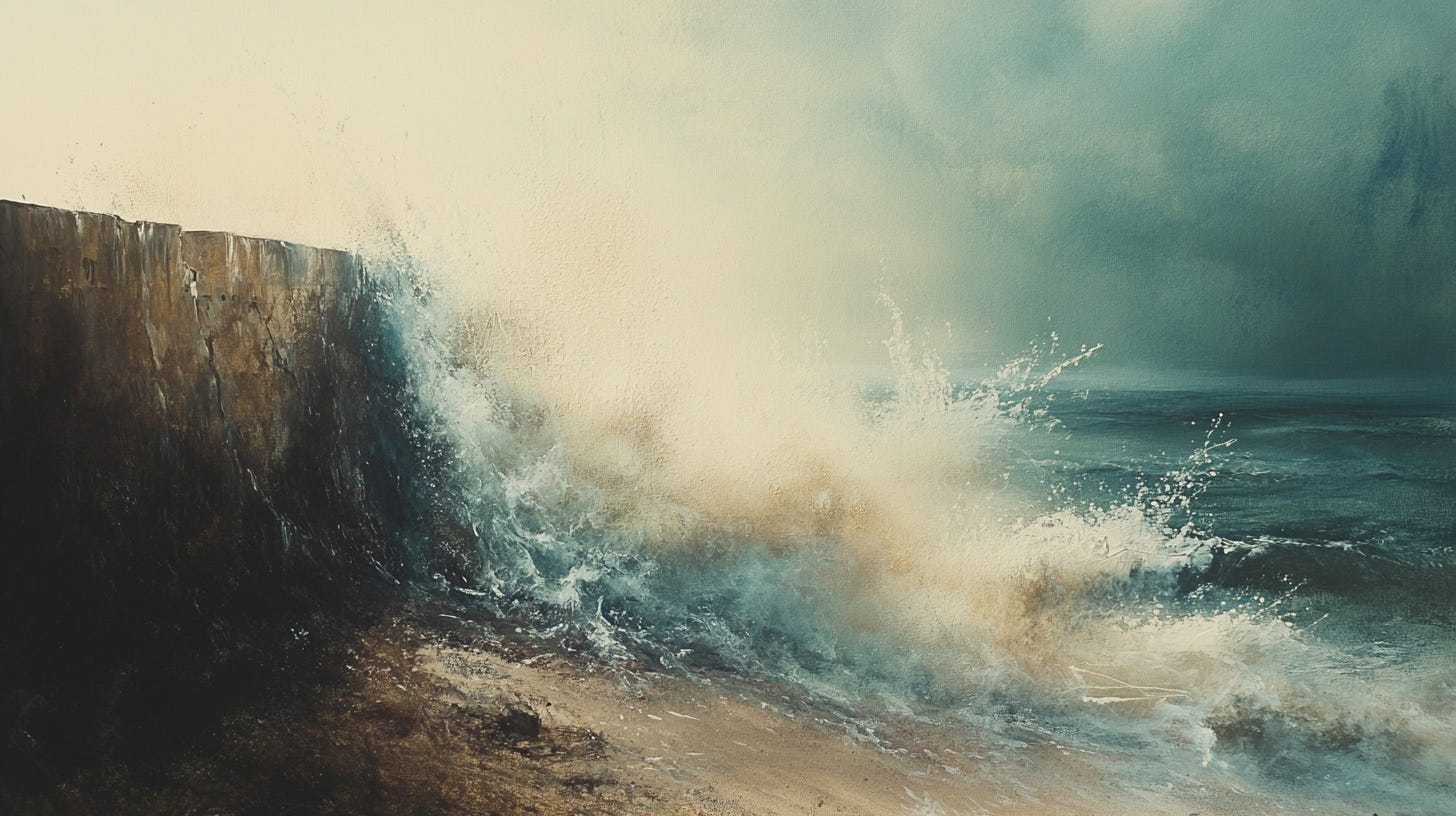
Champagne flutes chimed against crystal as diplomats drifted across manicured lawns, their laughter lifting into the Lima twilight. Inside the twelve-foot garden walls, the city's hard edges stayed politely out of sight. No one noticed the boy in the borrowed waiter's jacket, duct tape flaking at the toes of his boots, champagne bucket balanced on his tray.
Not until the garden wall exploded inward with a sound like thunder in a shoebox.
And just like that, the world outside surged forward in a bloom of dust and gunmetal, breaching more than stone. The boy reached into the bucket and pulled a gun from beneath the ice, forcing the guests to the ground.
This boy with the duct-taped boots is real. On December 17, 1996, he was one of fourteen members of the Túcpac Amaru Revolutionary Movement who stormed the Japanese ambassador’s residence in Lima, Peru during Emperor Akihito’s birthday celebration. They came looking for leverage, for spectacle. What they staged instead became a 126-day experiment in what happens when the walls we build between “us” and “them” suddenly crumble.
Walls aren’t made only of stone and brick. The human brain itself is a master architect of invisible barriers. Its outermost layer, the cortex, literally encloses the older, instinctive brain like a sheath. Within that cortical layer sits the prefrontal cortex, the newest and most sophisticated conductor of executive function. It filters chaos into order, sorting the world into neat categories: friend, enemy, familiar, foreign. It’s how we navigate complexity. But it’s also how we separate; how we look at another and see a threat, a symbol, an enemy, instead of a fellow human.
Yet beneath that high-order function lies something older, more porous. In a laboratory in Parma, Italy, around the same time those walls in Lima were breached, neuroscientist Giacomo Rizzolatti noticed something strange while studying how macaque monkeys reached for peanuts. When the monkey merely observed a researcher grasp the peanut, the same neurons fired in its brain as if it had done the reaching itself.
These “mirror neurons,” as he later called them, revealed a quiet but radical truth, a gap in the walls between self and other. The brain doesn’t always distinguish between doing and witnessing. The hand seen reaching for water activates the observer’s own motor cortex. Observing pain lights up the regions of our own pain matrix. We do not simply perceive—we participate. As neuroscientist Marco Iacoboni writes, mirror neurons “allow us to grasp the minds of others not through conceptual reasoning but through direct simulation.”
Before the prefrontal cortex can insist on difference, something deeper insists on sameness.
The hostages and captors in Lima would come to live what Rizzolatti uncovered in his lab over the course of over four months in forced communal breath, routine, and the slow collapse of imagined distance.
The strange intimacy that was forged between captors and hostages in the Lima siege would later be reimagined in Ann Patchett’s novel Bel Canto. Inspired by the stories that emerged from the crisis, she constructed a kind of narrative laboratory. Stripped of political context and reduced to its emotional essence, the novel becomes a case study in what happens when people built to mirror one another are trapped together long enough to forget why they were divided in the first place.
She resets the stage in an unnamed South American country. A cast of international dignitaries gathers at the vice president’s mansion to celebrate the birthday of a Japanese businessman. They are drawn by the promise of a private performance by Roxane Coss, the world’s most celebrated soprano. The president stays home to watch his soap opera. So when guerrillas storm in to kidnap him, they seize everyone else instead, and the novel’s quiet experiment begins.
The siege opens in terror. But terror has a shelf life. Days bleed into weeks. Routine emerges. And in that routine, something unexpected begins to take root.
Each morning, Roxane Coss sings. Her voice fills the mansion like light through windows and everyone, diplomat and guerrilla alike, stops to listen. Rebels and hostages take turns in the kitchen, learning each other’s rhythms with knives and onions. They sleep in shifts on the same floors, wake to the same rooster’s crow. Time itself changes. No longer measured by stock tickers and cabinet meetings, the days are organized around shared hunger, music, dusk.
And beneath it all, their brains are rehearsing each other. Something begins to shift.
A guerrilla’s voice cracks mid-threat. He’s fourteen, maybe fifteen. Another stares transfixed at the television during the evening news, reaching out to touch the screen as if it’s made of magic. A third removes her cap before sleep, and long hair spills out. She has been binding her chest, lowering her voice, becoming what war required.
In the mansion’s strange democracy of captivity, the hostages watch these moments not as strategists or statesmen, but as people. The careful categories begin to slip. The rebels are no longer just rebels. The monsters who burst through their walls are children who can’t write their own names, who weep at opera, who lean toward beauty like plants toward light. One has a gift for languages. One weeps when Roxane sings. One can debone a fish with startling grace.
Mirror neurons work beneath our awareness, beneath resistance. The same circuits that fire when we reach also fire when we see someone else reaching. When we witness pain, our own pain pathways stir. This is mimicry at the level of the nervous system. We do not simply watch one another. We practice one another.
Through repetition and proximity, nervous systems begin to tune. We feel what the other feels: the weight of their hunger, the relief of their laughter, the ache of their longing for home. While mirror neurons do not make us kind, they do make kindness possible. They are not empathy itself, but its architecture, allowing the body to rehearse connection before the mind decides what it believes.
This is how empathy begins. Not through grand declarations, but through accumulated moments of shared experience. As neuroscientist V.S. Ramachandran puts it, mirror neurons “dissolve the barrier between self and other.”
By the novel’s end, this dissolution is complete. The boundaries that once seemed absolute have become meaningless. Former enemies dream impossible futures together, a world where their children might play, where voices trained in mountain villages might fill concert halls, where the word “enemy” itself seems like a relic from another life.
But time was always the real enemy.
On April 22, 1997, Peruvian government forces stormed the residence. The siege ended exactly as it had begun, with gunfire, rupture, command. The walls went back up, built hastily from blood and necessity. The lines and labels were redrawn. Whatever had softened was snapped back into its original form.
All fourteen of the rebels were killed1.
In Patchett’s fiction, she offers no fairy-tale reprieve from this ending. The spell breaks the same way: suddenly, violently, finally.
And yet, something lingers.
The survivors leave changed by a kind of ghost pain, like a phantom limb. For four months, the boy with the rifle and the man with the Rolex had shared the same circadian rhythms, breathed the same air, eaten the same soup, startled at the same noises in the night. The garden wall was breached in one explosive instant. But the walls inside, the ones that divide self from other, fell slowly, like sand walls collapsing under tide.
They return to their former lives carrying a knowledge they cannot un-know: That the walls between us were always an illusion. That we are, despite our rational categories, permeable.
And in the end, that we are all waiting in the same room for a song to begin.
Thank you to Brigitte Kratz, Larry Urish, Dana Allen and Kathy Ayers for your help and encouragement on this piece!
The True Story: The 1996–1997 Japanese Embassy Hostage Crisis in Lima, Peru
On December 17, 1996, nearly seven hundred diplomats and dignitaries raised champagne flutes to Emperor Akihito’s birthday in the gardens of the Japanese ambassador’s residence in Lima’s affluent San Isidro district. Among the waiters circulating with silver trays, a handful of young militants from the Túpac Amaru Revolutionary Movement (MRTA) moved unnoticed, their serving platters concealing radios and ammunition. At 8:20 p.m., a coordinated explosion tore through the twelve-foot garden wall. Armed rebels poured through the breach.
Within minutes, the militants had overwhelmed both guests and security. Led by Néstor Cerpa, 43, the group included fighters as young as seventeen. Over the following days, they released all women, the elderly, and most foreign nationals, keeping seventy-two high-value hostages—cabinet ministers, supreme court judges, intelligence chiefs, and business leaders.
What followed defied every expectation of a hostage crisis. The mansion developed its own strange rhythms: afternoon soccer matches in the grand hall while cabinet ministers and businessmen cheered from gilt chairs; evening Mass for captors and captives alike led by Father Juan Julio Wicht, a captured Jesuit priest; shared meals and conversations that wandered from politics to family memories. Some hostages offered professional advice to their captors. A rebel commander fretted over an older diplomat’s health. The unexpected sympathy flowing in both directions was so pronounced that psychologists would later coin “Lima syndrome” to describe the inverse of Stockholm syndrome—captors developing protective feelings for their prisoners.
Released congressman Javier Diez Canseco shocked the press by describing the rebels as “mostly boys who don't want to die.”
This unlikely communion lasted 126 days. On April 22, 1997, Peruvian commandos executed Operation Chavín de Huántar, tunneling beneath the residence before storming in. Twenty-two minutes of gunfire left all fourteen rebels dead, along with two soldiers and one hostage. Seventy-one captives walked free, many carrying memories that would never fit the neat categories of victim and terrorist.
Rachel, your writing is exquisite. I just loved this article. Everything you write feels like an invitation for a deep, rich conversation amongst us about what it really means to be human.
You masterfully pull on so many threads again, and I learned so much from your piece – including "the Lima Syndrome" after the historical event that was then (also) "mirrored" in Bel Canto.
Simply superb, Rachel! 👏🏻