

Thinking with the Forest
Embodied Cognition in Richard Powers' The Overstory

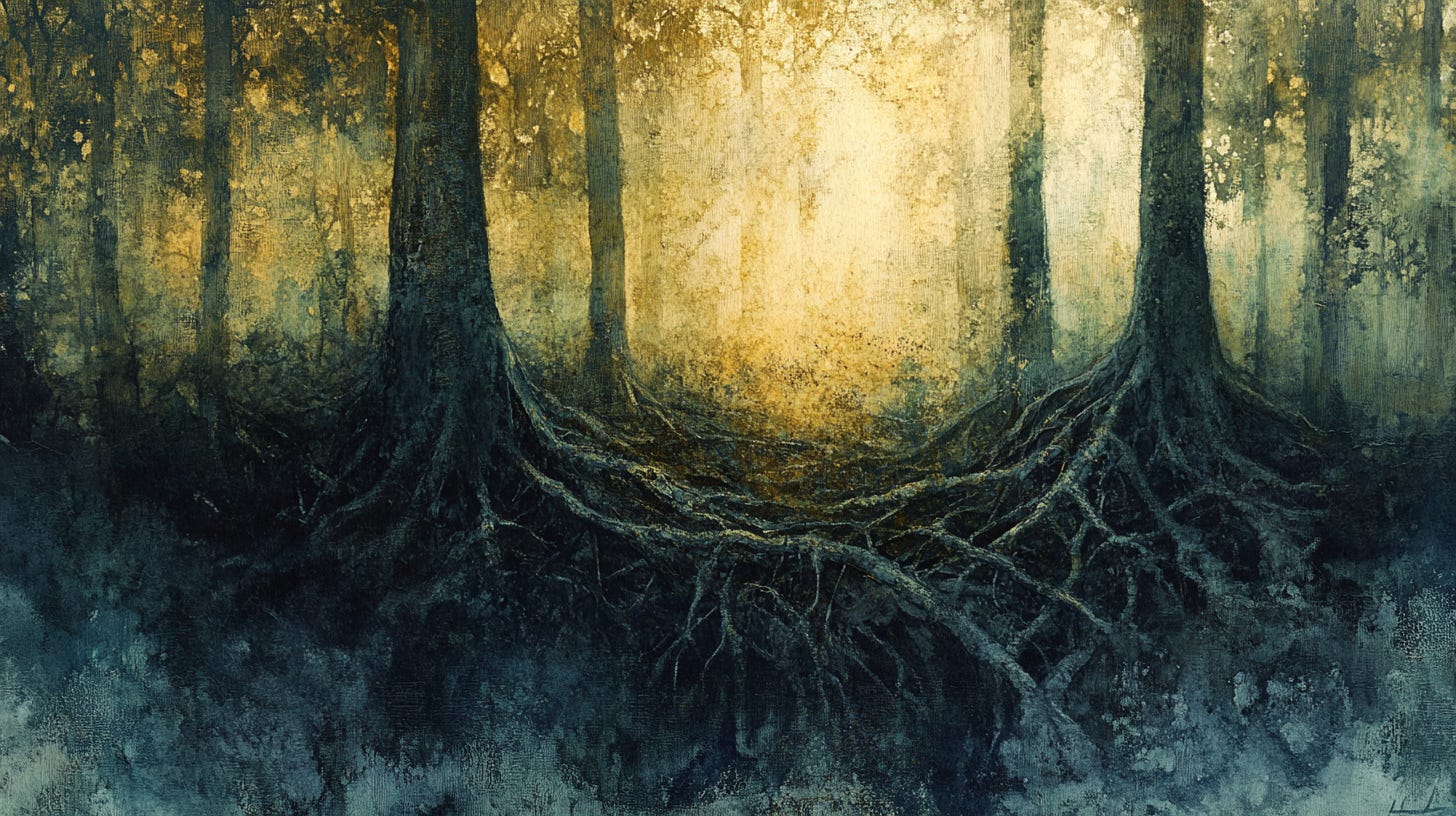
“There are no individuals. There aren’t even separate species. Everything in the forest is the forest.”
Patricia kneels in the duff, her fingers sifting through decomposing needles that smell of rain and time. Above her, Douglas firs breathe out their ancient chemistry, and she breathes it in. It is a conversation older than language, this knowing that bypasses words entirely.
In Richard Powers’ Pulitzer Prize-winning novel The Overstory, nine human lives intertwine with the fate of trees in a sweeping meditation on connection, time, and what we fail to see in the living world. Among these interwoven stories is that of Patricia Westerford, who will become a pioneering forest ecologist. Born partially deaf, young Patricia experiences the world through touch and sight where others rely on sound. Her schoolmates struggle to understand her different speech. But her father recognizes something precious in how she notices what others overlook, and becomes her guide to the world. On their walks through Ohio forests, he lifts her into the crook of a maple. “Watch,” he says. “Listen.” She does, her palm pressed to rough bark, learning the slow language of trees.
What Patricia discovers beneath those branches isn’t just botanical knowledge. It's a way of knowing itself. She doesn’t understand the forest by extracting pieces to study in isolation. She learns through participation, through the entanglement of her senses with the living world. Her body itself becomes the instrument of understanding.
This embodied way of knowing challenges centuries of scientific tradition. Since Descartes declared “I think, therefore I am,” Western thought has treated the mind as separate from the body, a disembodied intelligence operating like software on the hardware of the brain. This view dominated cognitive science for decades, imagining thinking as pure computation, sealed off from the messy influence of flesh and world.
But in 1991, a book called The Embodied Mind dismantled these boundaries. Written by neuroscientist Francisco Varela, philosopher Evan Thompson, and psychologist Eleanor Rosch, it proposed a radical alternative: the mind is not confined to the brain. Instead, cognition arises from the dynamic interplay of brain, body, and environment. How we perceive, learn, and make sense of reality emerges not from the brain alone but from this constant interaction.
Drawing from neuroscience, Buddhist philosophy, and phenomenology, Varela and Thompson argued that we don’t simply process information about an external world. We enact our understanding through movement, sensation, and interaction. Think of the mind like the concept of flight. A wing in stillness is merely architecture, and wind without a body merely weather. But when wing meets wind at the precise angle, when feathers adjust to invisible currents, flight emerges. Neither wing nor wind contains flight. It exists only in their meeting. Cognition is the same, arising not in the brain alone but in the dynamic encounter between our embodied selves and the world.
By the time Patricia becomes Dr. Westerford, her childhood way of knowing has evolved into scientific method. Palm still pressed to the bark, she studies how fungi connect tree roots in vast underground networks, how chemical signals pass between species, how the forest operates not as a collection of individuals but as a single, living system. Her intuitive understanding has matured into scientific conviction.
Her methods puzzle and even alienate her colleagues, who favor controlled environments and neatly defined experiments. “Why not bring samples back to the lab?” one graduate student asks. “It’s so much easier to control the variables.”
Patricia’s response carries the wisdom of someone who has learned from the trees themselves. “The variables,” she says simply, “are what make the forest.”
This tension reflects a deeper philosophical divide. Traditional science, like traditional cognitive science, seeks understanding through isolation and abstraction. But Patricia knows that complexity and interaction are not obstacles to knowledge. They are its medium. The forest itself is her laboratory, alive with meaning that cannot be recreated in tidy, sterile conditions.
Her approach embodies what Evan Thompson calls the “enactment of a world and a mind.” In the forest, Patricia doesn’t stand apart, representing a pregiven reality. She participates in creating understanding through each careful observation, each patient hour spent watching mycorrhizal networks pulse with shared nutrients. Knowledge emerges, as Thompson and Varela wrote, “in the midst of things.” Not in the abstract space of theory, but in the lived encounter between scientist and forest.
The scientific community is not ready for this shift. When Patricia publishes groundbreaking findings suggesting trees communicate and collaborate through underground networks, the response is swift and brutal. Academics dismiss her work as sentimental nonsense. Her university position vanishes. She becomes “the woman who hears trees talking,” a cautionary tale whispered in faculty lounges.
Years pass in exile from academia. Patricia retreats deeper into the woods, her understanding growing richer in solitude. She documents the slow conversations between Douglas fir and paper birch, the way a dying tree feeds its nutrients to its neighbors through underground networks. What her colleagues dismissed as sentiment reveals itself to her as sophisticated cooperation older than any human science.
Finally, new research confirms what Patricia proposed decades before. Trees communicate through airborne chemicals, electrical pulses, and the vast fungal web she first perceived through patient observation. The “wood wide web” enters scientific vocabulary. Forest ecology transforms from the study of competing individuals to the recognition of collaborative communities. Patricia’s field of science has finally caught up to her senses.1
But Patricia is already elsewhere, kneeling beneath the firs, her weathered hands reading the braille of bark and root. “She kneels and peers at mosses, lichens, and liverworts…She watches ants tending aphids, the way roots weave through the soil. Every outing is a lesson, every tree a teacher.” She has become what she studies, less an individual than part of the forest’s own intelligence.
In this, Powers shows us something beyond vindication. Patricia’s patient, embodied way of knowing didn’t just predict scientific discoveries. It modeled a different relationship with knowledge itself. Not extraction but exchange. Not distance but immersion. Her story insists that how we know matters as much as what we know.
We are not observers standing outside the world, taking notes. We are participants in an ancient, ongoing improvisation. Every step presses our story into the earth. Every breath exchanges molecules with the air. Understanding arrives in the meeting of inner and outer worlds in the only place they ever touch.
Here, in this moment, in this body, in this irreplaceable encounter with what is.
Thank you to Sandra Yvonne for your help on this one!
The character of Patricia Westerford in The Overstory is widely understood to be inspired by real-life forest ecologist Suzanne Simard, whose pioneering research reshaped our understanding of forest ecosystems. In the 1990s, Simard conducted controlled experiments in British Columbia that demonstrated how trees exchange carbon and other nutrients via underground mycorrhizal networks—a system sometimes referred to in popular media as the “wood wide web.” Her 1997 article in Nature provided the first conclusive evidence of carbon transfer between paper birch and Douglas fir via shared fungal networks, challenging prevailing notions of tree competition and forest dynamics. Her findings revealed that so-called “mother trees” can nurture younger seedlings, that dying trees redistribute resources to neighbors, and that forests behave as cooperative, interdependent systems rather than mere arenas of competition. Like Patricia, Simard initially faced skepticism from the scientific community. Her 2021 memoir, Finding the Mother Tree: Discovering the Wisdom of the Forest, chronicles her personal and scientific journey and has further cemented her influence on both ecological science and popular environmental discourse. Today, her research into plant communication and forest symbiosis continues to inform forestry practices and ecological theory worldwide.
See: Simard, S.W., Perry, D.A., Jones, M.D. et al. "Net transfer of carbon between tree species with shared ectomycorrhizal fungi." Nature 388, 579–582 (1997). https://doi.org/10.1038/41557
In parallel to the forest I am firmly rooted in the belief that we humans share a similar unseen network of connection that science cannot yet measure. The proof never needs to come from charts and graphs, but exists in the resonance I experience in my body and mind while reading your exquisite essay, like I'm a nearby tuning fork that is now humming at the same frequency as the notes of truth you have struck in your essay. Your writing goes deep and taps the same principles of organic connection as the forests you describe.
I read this paragraph three times: “We are not observers standing outside the world, taking notes. We are participants in an ancient, ongoing improvisation. Every step presses our story into the earth. Every breath exchanges molecules with the air. Understanding arrives in the meeting of inner and outer worlds in the only place they ever meet.”
Always a pleasure to see your work, Rachel 🖤